Have you ever lain awake wondering what kind of world your kids are growing up in? Wondering if anything you do as a parent can actually push back against the rising tide of anxiety, loneliness, and confusion that seems to be swallowing this generation whole?
You’re not imagining it. The numbers are real. Between 2014 and 2024, the suicide rate for young Americans aged 10–24 rose by 56 percent. Forty percent of high schoolers report feeling persistently sad or hopeless, and 1 in 5 has seriously considered suicide. An entire generation is drowning in a sea of screens, noise, and information their developing brains were never designed to filter.
It’s easy to look at problems that big and feel powerless. But here’s what I’ve come to believe: the answer to the macro crisis will have to come from somewhere other than a macro solution. A new app won’t do it, and neither will a policy or AI, no matter how impressive it gets. The deepest wounds of our culture were never created in Washington or Silicon Valley. They were created at the dinner table that nobody sits at anymore, in the bedroom where no one tucks anyone in, in the silence where a story used to be told.
The Root Goes Deeper Than the Headlines
The root of so many of society’s ills traces back to broken families and kids who never learned what it felt like to be safe. To be predictable. To be tucked in. To be told, the world is okay, you are loved, and there is a God who knows your name.
Every nation is just a collection of homes. Every generation is just a collection of bedtimes. The kids who grow up feeling safe, loved, and spiritually anchored are the ones who grow into adults who build, heal, lead, forgive, and tell the truth. The kids who don’t are the ones we lose.
What the Research Actually Says
Here’s where it gets hopeful, because the research is unambiguous about this. Children with consistent bedtime routines do better. Period.
Studies show that kids in families with optimal bedtime routines perform significantly better in working memory, attention, cognitive flexibility, and school readiness. Beyond sleep, bedtime routines foster parent–child attachment, prosocial development, and social–emotional development, and consistent routines are associated with decreased behavior problems and stronger self-regulation.
Family rituals, more broadly, give children a sense of identity and belonging, a documented protective factor against anxiety, depression, and risky behaviors in adolescence. Some studies have even shown that strong family rituals are associated with reduced drug overuse, depression, and suicidal ideation in young adults.
Think about that for a second. Researchers studying the youth mental health crisis keep landing on the same protective factors that any grandmother could have told you about a hundred years ago: a warm home, a steady routine, a bedtime story, a prayer.
But What Fills the Five Minutes?
If a five-minute bedtime ritual is one of the most powerful, evidence-based protective factors we have, the next question is what should fill those five minutes.
A scrolling cartoon? A throwaway story about a talking truck? Or something with the weight to actually shape a soul?
The stories that built the West came from one book: the Bible. They are the stories that built families, courts, hospitals, universities, abolition movements, and the very idea that every human being has dignity. These are religious stories, and they are also the deepest emotional and moral architecture our civilization has ever produced. David and the lamb. Daniel in the lion’s den. The brass serpent lifted up in the wilderness. They’ve held up for thousands of years because they tell children, and the adults reading to them, the truest things about courage, mercy, wonder, and being seen by God.
But here’s the gap: little kids connect to characters, to faces, to friends, long before they connect to stone tablets and ancient names.
Meet Beau, Scout, Willow, and Wren
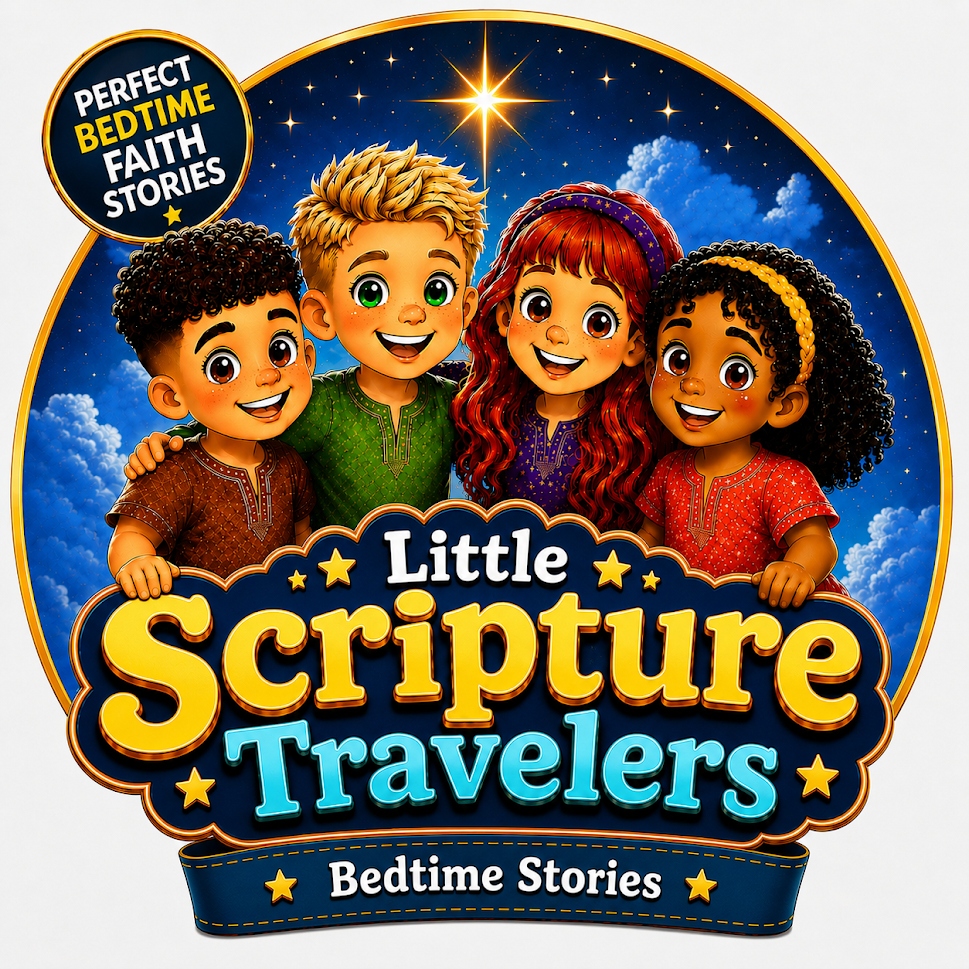
That’s where Beau, Scout, Willow, and Wren come in.
Beau the Brave shows them what courage feels like.
Scout the Seeker shows them how to wonder.
Willow the Warm shows them how to love.
Wren the Wonderer shows them how to pause and ponder what God is whispering.
And here’s where most parents stop and ask: why characters? Why not just read them the Bible straight? Because here’s a truth the research has been quietly proving for two decades: kids learn from relationships, even imaginary ones, far more than from information.
The Science of Why Characters Work
Developmental psychologists have a name for the bond a child forms with a beloved character: a parasocial relationship. It sounds clinical, but it describes something every parent has watched happen on the living room rug. A child meets a character, lights up, asks for them again, talks about them like a friend, and begins, without anyone telling them to, to act a little more like them.
This is science, and the studies bear it out. Researchers describe these as emotionally tinged relationships that powerfully shape early learning. In one Georgetown study, toddlers who had a parasocial relationship with a familiar character learned significantly more from that character, and even directed nurturing behaviors toward them during play, which was directly linked to better learning outcomes. Younger children, in particular, are more prone to forming these relationships, and they adopt those characters’ behaviors more firmly as a result.
Read that again. A child who loves a character will absorb that character’s values. No one has to lecture them. They love them, and that is enough.
There’s a second piece of science that explains why this matters so much for the stories we choose. It’s called narrative transportation, the moment a child becomes so emotionally absorbed in a story that they feel like they’re inside it. When children are emotionally engaged with characters, they internalize the values those characters display. Empathy does the teaching, so pressure never has to. Research consistently shows that moral stories, stories that impart values or teach a lesson, can both increase positive behavior in children and reduce negative behavior, because stories with vivid characters create clear mental pictures that lectures from mom or dad simply cannot.
A sermon is a seed thrown on concrete. A story is a seed planted in soil. And a story carried by a beloved character is a seed planted, watered, and tended to every single night.
The Flywheel
That’s the flywheel Little Scripture Travelers is built on:
Children fall in love with the characters → the characters help them fall in love with the stories → and the stories point them to the Savior.
Beau doesn’t just say “be brave.” He stands quietly beside little David as he picks up his stones, and a four-year-old learns that bravery has a face. Willow doesn’t just say “be kind.” She wraps her arms around the prodigal son as his father runs to meet him, and a child learns what mercy looks like before they have a word for it. Scout doesn’t just say “look closer.” He tilts his head up at the brass serpent in the wilderness, and a child learns that healing comes when we look to Christ. Wren doesn’t say “ponder.” She just sits with Mary, who treasured all these things in her heart, and a child learns that quiet wonder is holy.
This is how moral formation has always worked: through characters children love, walking them gently into truth, rather than through commandments shouted down at them.
The Quietest Revolution
Zoom back out. The macro crisis of rising anxiety, rising despair, rising deceit, and kids who don’t feel safe in their own skin was never going to be solved by another app, another government program, another awareness campaign. It is going to be solved one bedtime at a time. One nightly ritual. One small ceiling-staring child who learns, through Beau and Scout and Willow and Wren, that they are known by a God who loves them, that bravery and kindness and wonder and reflection are real, and that the world, for all its noise, still has stories worth trusting.
That’s the micro that builds the macro, and that’s the foundation. That’s the quietest revolution.
And it starts tonight, on the edge of your child’s bed, with five small minutes and a very old story told by four little friends.
Selected Research
- Kitsaras, G. et al. (2018). Bedtime routines, child wellbeing, and development. BMC Public Health.
- Mindell, J. A. & Williamson, A. A. (2018). Benefits of a bedtime routine in young children: Sleep, development, and beyond. Sleep Medicine Reviews.
- Portes, J. R. M. et al. (2022). Family rituals, sense of belonging, and adolescent mental health.
- Malaquias, S. et al. (2015). Family rituals as a protective factor against drug use, depression, and suicidal ideation.
- Calvert, S. L. & Richards, M. N. (2014). Children’s parasocial relationships with media characters. Georgetown University.
- Brunick, K. L. et al. (2016). Children’s future parasocial relationships with media characters. Journal of Children and Media.
- CDC Youth Risk Behavior Survey (2023) and CDC suicide trend data, 2014–2024.
- McGorry, P. et al. (2025). The youth mental health crisis: analysis and solutions. Frontiers in Psychiatry.
Start Tonight
Five minutes, one scripture story, and four little friends to guide the way. Your family’s bedtime routine starts here.
Choose Your Plan