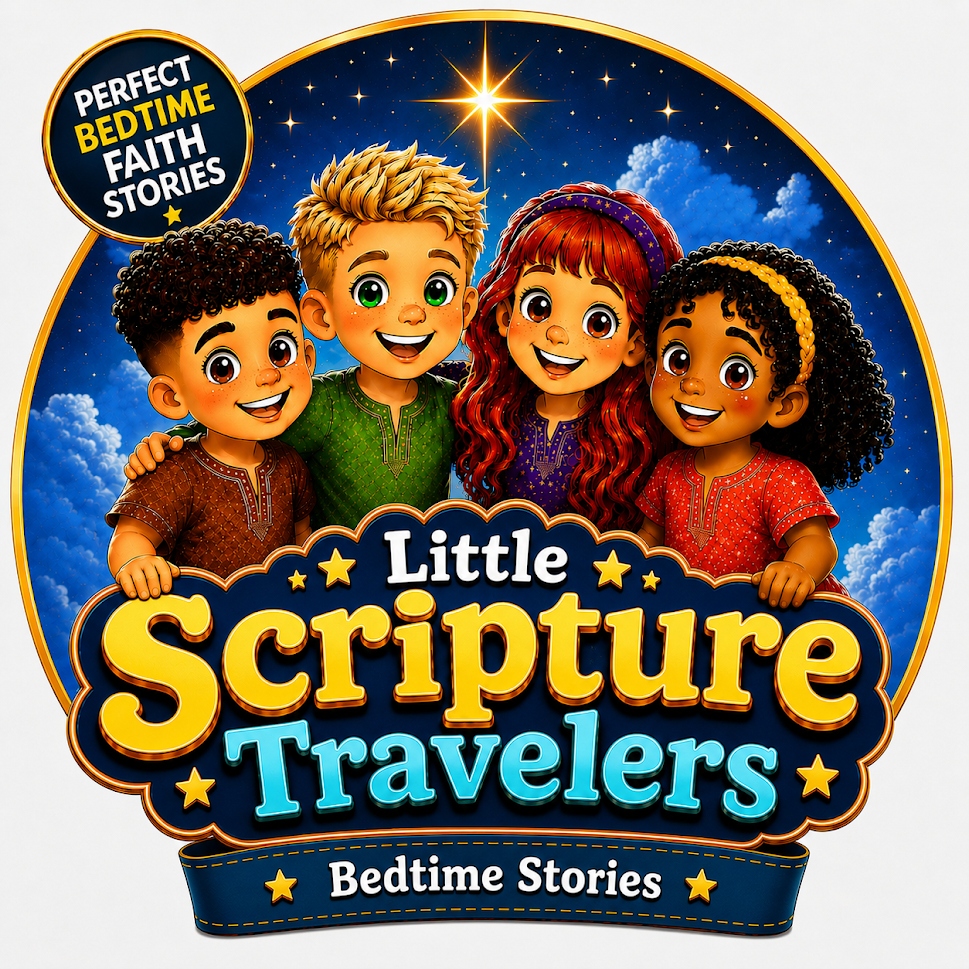
Four little friends who guide your child through every scripture story.
In every Little Scripture Travelers story, your child journeys alongside Beau, Scout, Willow, and Wren — four gentle observer-guides who model how to feel the scriptures, not just hear them. They are the helpers who whisper, "It's okay to be brave," "It's holy to wonder," "Love starts small," and "Pause and listen." Meet each of them below.
When I sat down to build Little Scripture Travelers, I kept circling one simple truth I'd watched play out at my own children's bedside: a child will not lean in for a doctrine, but they will lean in for a friend. They'll ask for "one more" not because of the message, but because of who's in the story with them.
So the travelers came first on purpose. They are not decoration around the scriptures — they are the doorway into them. A child meets Beau, Scout, Willow, and Wren, and learns to love them. And because they love them, they trust them. And because they trust them, they will follow them anywhere — including three thousand years back, into Ruth's loyalty, David's courage, and Solomon's quiet wisdom.
This isn't a hunch — it's how young children are wired to learn, and it's well supported in developmental research.
Picture a small child at the bottom of a very tall step. The scriptures are up on that step — rich, ancient, a little out of reach. The travelers are the hand that reaches down, takes hold, and lifts the child up to where the story is. Once they're up there, the view is theirs forever.
This is why a child who falls for Elsa wants the dress and sings every line of Frozen; why a child devoted to Bluey copies her games and her kindness; why kids salute with the Paw Patrol pups. Dora the Explorer is a telling case — those pauses where Dora asks and waits are a deliberate, research-backed design choice built to spark the very parasocial bond described above. And Sesame Street, the most-studied of them all, is the clearest proof that the bond can carry real learning. In every case the affection comes first, and the lessons ride in on it.
That chain — love the character → trust the character → imitate the character → follow the character into the story — is the entire engine of Little Scripture Travelers.
One honest note I hold myself to: none of this guarantees a child's faith, and I never want our work to pretend it does. What good characters can do is open a door and make a child want to walk through it. The crossing belongs to the family, the home, and the Spirit. We build the bridge; we trust the rest.
Key sources: Calvert & Richards, Children's Parasocial Relationships (2014); Bond & Calvert, Parasocial Breakup Among Young Children (2014); Gola, Richards, Lauricella & Calvert, on parasocial relationships and early math learning (2013); Albert Bandura, Social Learning Theory (1977); Kearney & Levine, "Early Childhood Education by Television: Lessons from Sesame Street," American Economic Journal (2019).

"Bo the Brave"
"Big heart, brave start!"
Beau is the friend your child reaches for when the scripture story asks someone to be brave. He has a steady heart, a quiet smile, and a lantern that glows a little brighter when he's near. He doesn't pretend the hard things aren't hard — he just shows little ones that brave is something Heavenly Father places inside them, ready to be lit.
David walks toward Goliath. Esther approaches the king. Peter steps onto the water. Nephi returns for the plates. Anytime the story whispers, "This is going to take courage," Beau is there — helping your child feel brave alongside the hero.
That brave isn't the absence of fear — it's the moment we take a faithful step anyway. Beau models small, ordinary courage: trying again, telling the truth, standing up, praying out loud.
Obedience is courage's quiet twin — it takes real bravery to follow God when the path is hard or doesn't make sense yet. Beau already lives "I will go and do"; obedience is that courage pointed at God's word.
Naaman dipping seven times in the Jordan (2 Kings 5) · "If ye love me, keep my commandments" (John 14:15)
✦ "Be strong and of a good courage." — Joshua 1:9

"Scout the Seeker"
"Look and see — what could it be?"
Scout sees what others miss. A burning bush. A small voice. A star moving low across the sky. Scout is the friend who teaches little ones that wondering isn't naughty — it's holy. He moves through every story with eyes wide open and a heart that asks, "What is Heavenly Father showing me here?"
Moses turns to see the burning bush. The wise men follow the star. Samuel hears his name in the night. The children ask, "But why?" Wherever the scripture is full of wonder, Scout is leaning in — and inviting your little one to lean in too.
That curiosity is a gift. That questions are how faith deepens. That noticing small things — a kind word, a quiet feeling, a beautiful sky — is how children begin to recognize the Spirit.
Hope is curiosity aimed at the future. Scout's "what could it be?" is the very posture of hope — leaning forward, expecting that God has something good waiting to be found.
"They that wait upon the Lord… shall mount up with wings as eagles" (Isaiah 40:31) · the wise men following the star
✦ "Ask, and it shall be given you; seek, and ye shall find." — Matthew 7:7

"Willow the Warm"
"Warm hugs, warm hearts!"
Willow is the friend who notices when someone is hurting. She kneels close. She speaks softly. She is the warmth your child feels when the Savior gathers little children in His arms — and the small, kind voice that whispers, "You can be that warmth, too."
The Good Samaritan stops on the road. Jesus blesses the children. Ruth refuses to leave Naomi's side. Whenever the story turns tender — whenever someone needs a kind heart — Willow is there, showing little ones how love looks up close.
That love is something small hands can do. That kindness is a holy act. That the Savior's tenderness lives in us when we slow down enough to share it.
Forgiveness is compassion grown all the way up — the hardest, most loving thing a tender heart can do.
Joseph forgiving his brothers (Genesis 45, 50) · "Father, forgive them" (Luke 23:34)
Gratitude is love noticing what it's been given — the warm overflow of a thankful heart.
The one leper who turned back to say thank you (Luke 17:15–16)
✦ "Be ye kind one to another, tenderhearted." — Ephesians 4:32

"Wren the Wonderer"
"Pause and ponder — what a wonder!"
Wren is the quietest of the four — and somehow the one little ones remember most. She lingers a moment longer. She closes her eyes when the story turns sacred. She is the gentle reminder that scripture isn't meant to be rushed through — it's meant to settle into our hearts.
Mary "ponders these things in her heart." The Savior teaches in quiet moments on the mountain. Enos prays all day long in the woods. Whenever the scripture invites stillness, Wren is there — modeling what it looks like to truly listen.
That stillness is sacred. That pondering is a kind of prayer. That little ones don't have to be loud or quick to be close to Heavenly Father — they just have to be present.
Humility is where wisdom begins — the one who pauses to ponder knows they don't know everything, and bows before God.
"With the lowly is wisdom" (Proverbs 11:2)
Patience is the wisdom to wait and trust God's timing instead of rushing ahead.
"Wait on the Lord" (Psalm 27:14) · "Let patience have her perfect work" (James 1:4)
✦ "Be still, and know that I am God." — Psalm 46:10
Every scripture story your child hears is rich with emotion — courage and curiosity, tenderness and quiet wonder. The four Travelers are how we help little hearts recognize what they're feeling, name it, and grow into it. They walk alongside the heroes. They sit close to the Savior. And night after night, they help your child see themselves in the story too.
When the story asks for a brave heart.
When the story invites wonder.
When the story turns tender.
When the story calls for stillness.
Because no single child is just one thing — and no single virtue carries the whole gospel. The brave child and the gentle child both need a way in. One character can only offer one doorway.
Because little minds hold small casts best. A tight circle of friends is easy to keep close and easy to love. Too many faces and no one becomes theirs.
So that every child finds the traveler who feels most like them — and then grows toward the ones who aren't. The four don't compete; they complete each other.
Put together, they model a whole disciple: brave and curious, tender and wise, all at once. A child who loves all four has learned to hold all four — and that is quietly the whole goal.
When I started reading scripture stories with my own children at bedtime, I noticed something. The stories themselves are powerful — but little ones don't always know how to feel what's happening. They need a friend in the story with them. Someone who shows them when to be brave, when to wonder, when to be soft, when to sit still.
So Beau, Scout, Willow, and Wren were born — four small companions who help my own children (and now yours) experience scripture with their hearts, not just their ears. They don't replace the heroes of the story. They walk alongside them — and alongside your child — so the lesson doesn't end when the book closes.
This is also why the travelers never stand in front of the scripture story — they stand inside it. They are emotional witness-guides. They feel the moment alongside the child, modeling wonder, reverence, and warmth, until the child borrows that feeling and makes it their own. And it's why God is almost always shown as warm light and gentle rays rather than a face or figure — the reverence stays intact, the child's imagination stays tender, and the holy stays holy. The travelers point toward the light; they never pretend to be it.
There is one sacred exception. In the First Vision, Heavenly Father and Jesus Christ appeared together to the boy Joseph Smith — and the whole truth of that moment is that They were seen, standing in the light above him. So in that single scene, and only there, Heavenly Father is shown, because the story itself is the seeing. Everywhere else, the warm light holds.
My prayer is that, night after night, your little ones grow to love these four friends — and through them, grow to love the scriptures themselves. I won't promise faith; that isn't mine to promise. But I can promise a bridge — characters worth loving, stories worth returning to, and a warm circle of light at the end of the day. The rest is the work of a family and the gentle pull of the Spirit, and I trust them to do it.
— LeviFounder, Little Scripture Travelers
At dinner or before bed tonight, ask your child these four small questions. Listen to which one lights them up — that's tonight's Traveler.
"What was the bravest thing you did today?"
"What did you notice today that no one else did?"
"Who needed a kind heart from you today?"
"What did you think about that felt important?"
The Travelers are waiting in tonight's scripture story — and we'd love to send you the first one free.
Try the First 7 Days Free See All Plans